
Geothermal energy is heat stored beneath the Earth’s surface that can be harnessed as a local source of renewable energy. It is often said that Hungary is a “geothermal powerhouse” — but what does the situation actually look like in numbers, and what can realistically be achieved in the coming years and decades?
The geological factors behind Hungary’s geothermal potential are explained in more detail in our Knowledge Hub piece, “Why Does the Pannonian Basin Have Such Strong Geothermal Potential?”. Here, we look at the current state of Hungary’s geothermal sector in 2026, its key challenges, and what is needed to move the sector forward.
1. Geothermal district heating in Hungary today
According to an analysis published by the State Audit Office of Hungary in 2025, 6.5% of the country’s approximately 47.5 PJ of gross heat production comes from geothermal sources. The theoretical potential is estimated at around 60 PJ per year from thermal water alone, rising to approximately 100 PJ when heat pumps are included [1]. However, heat demand and geothermal potential cannot be directly matched, as the location of settlements, the technological maturity of heating systems, and the distribution of geological resources vary considerably. Full replacement of conventional heat sources will therefore never be achievable.
Today, geothermal energy is used by district heating providers in 11 settlements, while thermal-water-based district heating systems are operating in a further 14 settlements. The 2024 National Geothermal Utilisation Concept (NFHK) identifies 20 of the 77 settlements that are not currently supplied by geothermal district heating as having no high geological risk associated with the transition. This suggests that the development of geothermal district heating systems in around 20 settlements could be a realistic target over the next 5–10 years [2]. In areas where the geological risk is higher, this risk can be reduced through geological exploration. Efforts to achieve these targets should focus particularly on Budapest’s district heating system, where the greatest impact can be achieved due to economies of scale.
The capital cost of a geothermal heating system consisting of a production and reinjection well pair with a thermal capacity of 3–8 MW, district heating pipelines, and heat-exchange and mechanical equipment at the heat centre is estimated at HUF 2–6 billion, depending on the technical conditions. For planning purposes, an average investment of approximately HUF 3.5–4 billion per heating system should be assumed.
It is also important to emphasise that improving the energy efficiency of district heating systems and Hungary’s building stock would not only reduce overall energy consumption, but would also enable geothermal energy to account for a larger share of the heat supplied to modern heating systems.
Over several decades, geothermal energy—including shallow geothermal energy—could potentially account for as much as 50–70% of Hungary’s energy use for heating. Achieving this would, however, require the widespread adoption of modern, low-temperature heating systems, such as underfloor and other surface heating or air-heating systems, as well as a significant shift in approach. While conventional radiator heating typically requires a supply water temperature of 60–75°C, low-temperature systems generally operate with supply temperatures of 30–45°C or lower. Thermal water with temperatures above 30°C is readily accessible across most of Hungary, with the exception of mountainous areas. Sustainable long-term utilisation would, of course, also require responsible water management alongside a more energy-efficient building stock.
2. Geothermal power plants and electricity generation
At present, Hungary has only one operating geothermal power plant, in Tura, with a gross capacity of 3 MW. In Croatia, under geological conditions that are comparable to those found in parts of Hungary, a 17.5 MW geothermal power unit is already in operation. In our view, developing a total of 50–200 MW of geothermal power generation capacity in Hungary could be a realistic target, based on a portfolio of smaller plants with capacities of 3–5 MW and, in some cases, 10–15 MW. The investment cost of a geothermal power plant capable of generating 5 MW of electricity is approximately HUF 10–14 billion, depending on the local technical conditions. It is advantageous if there is a local heat market — industrial, agricultural or residential — as this makes it possible to combine electricity generation with useful heat production.
Geothermal power plants are considered baseload generation facilities: they are not dependent on weather conditions and can generate electricity continuously. While geothermal plants can achieve capacity factors of 80–90%, weather-dependent renewables have considerably lower capacity factors when measured over the full 8,760 hours of a year. In Hungary, solar power has an average annual capacity factor of around 15–20%, while wind power plants operate at roughly 23–28% of their maximum capacity. This means that, when operating hours are taken into account, a geothermal power plant can generate around 3–6 times as much electricity as a solar or wind power plant with the same nominal capacity.
3. Can geothermal energy replace natural gas in Hungary within 5–10 years?
According to the NFHK, geothermal energy could replace 0.5–0.7 billion m³ of natural gas by 2030 and 1–1.2 billion m³ by 2035 [2]. This would require most exploration projects to be completed by 2028, a target that can no longer realistically be met given the funding shortages and lack of development in recent years. By comparison, Hungary’s total natural gas consumption was approximately 8.5 billion m³ in 2024, while before the 2022 energy crisis it fluctuated between 9 and 11 billion m³ per year.
Based on our own nationwide assessment, a more realistic target over a 5–10-year horizon would be to replace 0.2–0.6 billion m³ of natural gas per year with geothermal energy, through a combination of heat and electricity generation, given the current state of Hungary’s district heating infrastructure and building stock. We estimate that replacing the first 300 million m³ of natural gas per year through geothermal heat and power generation would require an investment program of approximately HUF 400 billion. The expected operating lifetime of the power plants exceeds 25 years.
4. How the energy crisis changed geothermal in Hungary
For natural gas prices, the Dutch TTF benchmark can be used as a reference. However, given its volatility, a single average price would not adequately reflect the reality of the market.
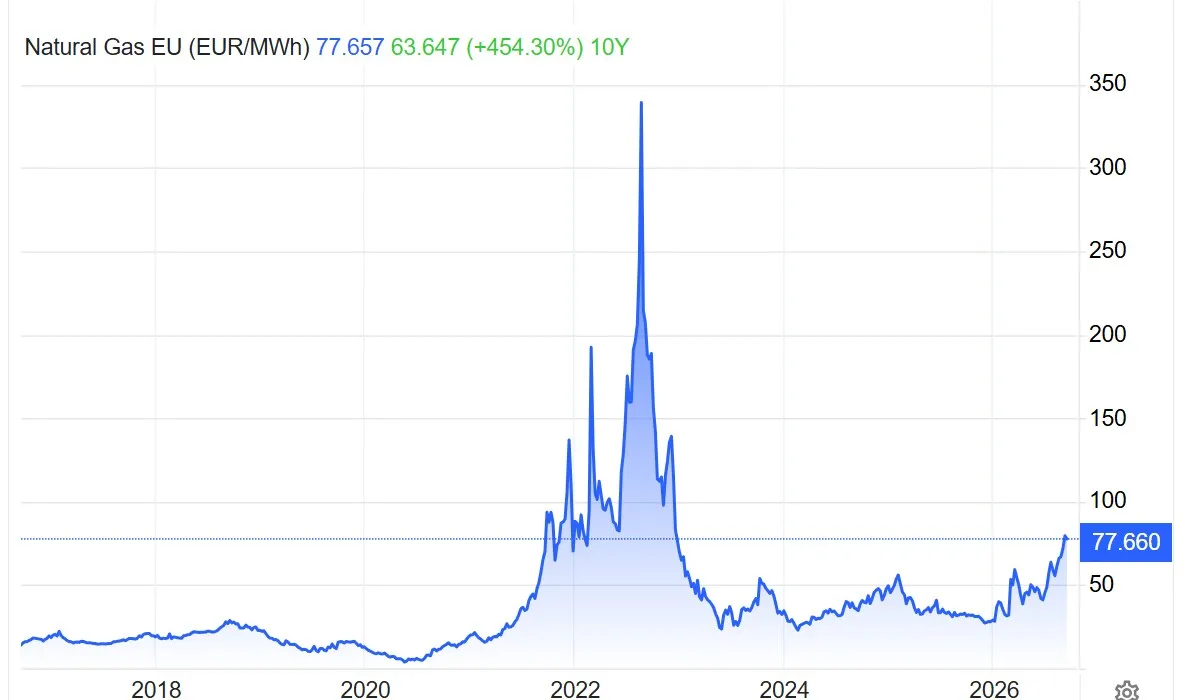
Figure 1. Changes in Dutch TTF natural gas prices (EUR/MWh). Source: tradingeconomics.com
During the period of exceptionally high prices shown in the graph above, 2023 alone saw HUF 1,062 billion paid to MVM in compensation for the increase in gas prices, with a further HUF 359 billion provided to gas-fired district heating providers [3]. Overall, the most recent energy crisis, which lasted approximately 2–2.5 years, generated an estimated HUF 3,000–4,000 billion in additional expenditure for the Hungarian state budget under the “utility cost protection” scheme [4][5].
One of the key advantages of geothermal systems is that they reduce exposure to global energy market volatility. While geothermal projects are capital-intensive to develop, their operation requires no fuel and involves relatively low and predictable operating costs. The main ongoing costs are electricity for pumping and maintenance. The price of geothermal heat is therefore largely decoupled from fluctuations in international gas markets and, once the investment has been paid back, can remain stable for decades.
Since the 1970s, five major global energy crises can be identified that have had a profound impact on the world economy. They have been accompanied by numerous smaller regional or shorter-lived price and supply shocks. Against this background, the question is not whether another similar crisis will occur, but when it will happen — and how well we will be prepared for it.
Hungary’s geothermal resources are indeed exceptional. If the necessary funding, political commitment and expertise are brought together, geothermal energy could play a major role in Hungary’s heating sector over the course of several decades, potentially reaching a 50–70% of heat produced for supply, while geothermal power generation could potentially reach 150–250 MW — roughly one-third to one-half of the capacity of a single Paks reactor unit. When we consider how Hungary heated buildings and generated electricity 50 or 100 years ago, these figures are not necessarily as far-fetched as they may initially seem. Nevertheless, achieving them would require substantial effort and a targeted, long-term development policy.
5. What geothermal in Hungary needs to break through
The development of geothermal energy in Hungary is constrained primarily not by geological conditions, but by factors above ground: the technical condition of existing networks, distortions in the domestic energy market, and the regulatory environment. In our view, the following conditions would need to be met for the levels of deployment described above to become achievable.
1. Lower temperature networks, combined with building energy-efficiency upgrades. Hungary has district heating systems in 95 municipalities, supplying around 675,000 households. However, most of these networks were built between 1950 and 1990 and have undergone only limited modernisation since then. This creates a fundamental paradox for the sector: across much of the country, geothermal water at 40–50 °C is relatively readily available and sufficient to heat a modern building, yet it cannot be fed into district heating systems operating at 90/70 °C. Modern fourth-generation systems operate at 50/30 °C or even 40/20 °C, while 60/40 °C systems are still uncommon in Hungary. Our estimates suggest that in a system the size of those in Győr, Szeged or Miskolc, reducing the return temperature by just 5–10 °C could unlock several tens of thousands — and under favourable conditions, up to 100,000 — GJ of additional usable heat per year, without drilling a single new well. Energy-efficiency upgrades to buildings and geothermal development should therefore not be treated as two separate issues: the former is a prerequisite for the widespread deployment of the latter.
2. A differentiated and predictable support system. In countries where geothermal energy has reached significant scale, there is no single support scheme that applies to all projects. Support is differentiated according to the type of developer, the intended use and the stage of the project. For municipal and community heating projects, upfront non-repayable capital grants combined with long-term concessional financing are effective instruments. For industrial and market-based projects, a predictable market framework and ongoing support linked to the amount of energy actually produced are more appropriate. For power generation, an operational support scheme based on the electricity actually generated, paid per kWh over 12–15 years, is arguably the most defensible approach: it only places a burden on the public budget when electricity is actually produced, while leaving the geological risk with the investor. State-supported, insurance-type risk mitigation funds also belong in this category, and several proposals for such mechanisms have already been put forward [6]. Based on our estimates, replacing 300 million m³ of natural gas per year would require an investment program of around HUF 400 billion. Provided the right conditions are in place, a significant share of this investment could be financed with the participation of private-sector players. Such a program would need to be structured as a multi-year, phased framework rather than through isolated calls for proposals.
3. Permitting and barriers to entry. Today, the permitting process combined with public procurement procedures often takes twice as long as the actual design and construction phases of a project. In addition to simplifying the regulatory framework, this could be shortened primarily by ensuring that the relevant authorities have sufficient specialist capacity.
4. Addressing Budapest’s specific situation. Budapest combines the country’s largest heat market with excellent but finite geothermal conditions. This means that any geothermal development within the capital would need to be based on close technical oversight and a project-specific set of criteria in order to establish a system acceptable to the broad range of stakeholders involved. If a modern geothermal district heating system can be developed in Budapest under appropriate conditions, it could by itself multiply the currently installed geothermal capacity in the country.
Two further conditions are already part of the broader professional consensus, so we will only mention them here: ensuring an adequate pipeline of trained specialists and effective enforcement of reinjection requirements to support sustainable groundwater resource management. Both are discussed in greater detail in the literature [6].
None of these points represents a new insight, and each has already been addressed individually in Hungarian professional and policy documents. The difference lies in implementation. Geothermal is a slow-moving industry: decisions that are postponed today will show up as capacity shortages five or ten years from now. We cannot choose when the next energy price shock will occur. We can, however, choose how well prepared we are when it does.
Sources
- A geotermikus energia hasznosítása Magyarországon – Stratégiai, jogi és pénzügyi feltételrendszer. Elemzés, szerk. Vargha B., Állami Számvevőszék, 2025. január.
- Nemzeti Földhő Hasznosítási Koncepció. Energiaügyi Minisztérium, 2024. Elfogadta a Kormány az 1304/2024. (X. 3.) Korm. határozattal (Magyar Közlöny, 2024. évi 100. szám). Elérhető: kormany.hu/dokumentumtar/nemzeti-foldho-hasznositasi-koncepcio
- Népszava, 2024. október. Az MNB költségvetési jelentése alapján készült cikk, amelyben a lap kormányhatározatokból összesítette a 2023-as kifizetéseket (MVM 1062 milliárd Ft, távhőszolgáltatók 359 milliárd Ft). nepszava.hu/3253765_mnb-koltsegvedesi-jelentes-rezsivedelmi-alap
- Költségvetési jelentés. Magyar Nemzeti Bank, 2024 (féléves jelentés). A Rezsivédelmi Alap 2023-as tényleges kiadására és a 2024-es előrejelzésre vonatkozó adatok. Elérhető: mnb.hu
- Rezsicsökkentés: változó mértékű teher az államnak. Világgazdaság, 2024. október. Az MNB-jelentés adatainak összefoglalója. vg.hu/energia-vgplus/2024/10/rezsicsokkentes-valtozo-merteku-tehet-az-allamnak-kiszamithatosag-a-lakossagnak
- Szanyi J. 2025: Javaslat a geotermikusenergia-hasznosítás fellendítésére – „Megint s megint – szünetlen”. Földtani Közlöny 155/3, 257–263. DOI: 10.23928/foldt.kozl.2025.155.3.257